Jacksonville Through the Years
The History of Jacksonville, Texas
Jacksonville did not simply grow where it began. It moved, adapted, changed industries, built institutions, and repeatedly reshaped itself as East Texas changed around it.
What began as a small settlement near Gum Creek became a railroad town, an agricultural shipping center, a place known across Texas for tomatoes, a manufacturing community, a center for education and healthcare, and the Jacksonville generations know today.
The Land Before Jacksonville
Before there was a town called Jacksonville
Jacksonville’s story begins before the Jacksonville name ever appeared on a map.
Long before Gum Creek became Jacksonville, this part of East Texas was part of a much larger Native and settler history. Cherokee families led by Chief Bowl had established communities in East Texas, and in 1836 Cherokee leaders signed the Houston-Forbes treaty with officials of the new Republic of Texas.
The Texas Senate did not ratify that treaty. As more settlers moved onto land claimed by the Cherokee, conflict intensified. On October 5, 1838, members of the Killough family were killed near old Larissa, northwest of present Jacksonville. The Killough Massacre became one of the best-known episodes from this violent period.
The conflict did not end there. In 1839, the Cherokee War culminated in military action that forced the remaining Cherokee communities out of East Texas. Cherokee County history therefore begins with displacement as well as settlement.
Within only a few years, new settlements spread across the county. Cherokee County itself was organized in 1846, and attention soon turned toward a small area along Gum Creek where the pieces of Jacksonville were beginning to appear.
Gum Creek
A settlement begins to take shape
In the 1840s, the future Jacksonville was still a small settlement developing around Gum Creek. Homes, a school, churches, a blacksmith shop, and a post office became some of the first pieces of organized community life.
The history of Jacksonville is closely connected to two early residents: Jackson Smith and Dr. William Jackson.
An early school
The Handbook of Texas records Jacksonville’s first school opening in 1846 and describes it as the second school in Cherokee County.
Settlement along Gum Creek
The settlement that would become Jacksonville developed on the east bank of Gum Creek.
The Gum Creek post office
A post office was authorized under the Gum Creek name, and Jackson Smith became postmaster.
A Town Gets a Name
Gum Creek becomes Jacksonville
Jackson Smith had established a home and blacksmith shop in the developing settlement. Nearby, Dr. William Jackson was also part of the early community.
In 1850, Smith had a townsite and public square surveyed near his home. The name Jacksonville was chosen through the connection to Jackson Smith and Dr. William Jackson.
In June 1850, the post office officially changed its name from Gum Creek to Jacksonville.
Around the growing town were the institutions that helped turn scattered settlement into community. Baptist and Methodist congregations had already begun establishing themselves, and a Masonic lodge followed during the 1850s.
This was the first Jacksonville: a small East Texas town centered near Gum Creek, built around homes, businesses, religion, education, and a public square.
War and Recovery
The Civil War disrupted the young town
Jacksonville had existed for barely a decade when the Civil War reached into nearly every part of life in Cherokee County.
The county’s prewar economy depended heavily on agriculture and enslaved labor. In 1860, Cherokee County had 12,098 residents, including 3,250 enslaved people. That figure is countywide, not a Jacksonville-only count, but it provides important context for the society surrounding the young town.
Several hundred Jacksonville men served in Confederate units. Jacksonville raised Company K of the 18th Texas Infantry, one of the units organized from Cherokee County during the war.
Local history describes a town whose business activity contracted sharply during the conflict. Cherokee County history records the George K. Grimes Store as the only Jacksonville firm continuing business through the war years.
The end of the war did not bring an immediate return to stability. Jacksonville entered the postwar years with a weakened economy, social upheaval, and local conflict. The town that emerged from those years was still small and geographically isolated from the transportation system that would soon determine its future.
A county shaped by slavery
Cherokee County’s population included 3,250 enslaved people on the eve of the Civil War.
Jacksonville’s Company K
Company K of the 18th Texas Infantry was raised from Jacksonville and served west of the Mississippi River.
A difficult recovery
Economic disruption and postwar unrest shaped Jacksonville’s years immediately before the railroad arrived.
The Turning Point
The railroad missed Jacksonville, so Jacksonville moved
Few events shaped Jacksonville as dramatically as the arrival of the railroad.
The International-Great Northern Railroad was built through Cherokee County, but its route missed the original Jacksonville townsite by a few miles.
For a nineteenth-century town, being separated from the railroad could mean being separated from passengers, freight, markets, investment, and future growth.
Jacksonville responded in an extraordinary way.
Residents surveyed a new townsite along the railway. During the fall of 1872, most of the community relocated about two miles east to the new site near the tracks.
Jacksonville had effectively moved toward its future.
The railroad did more than change Jacksonville’s location. It changed what Jacksonville could become. The tracks connected local farmers, merchants, businesses, and residents to a much larger transportation network.
Building Again
A new Jacksonville rises beside the railroad
After the relocation, Jacksonville entered a new period of growth. The railway was now part of the town’s daily life, and new institutions appeared around the rebuilt community.
Jacksonville Collegiate Institute opened in 1873. That same year, the Texan Intelligencer began publication.
In 1881, a public school was organized and took over the assets of Jacksonville Collegiate Institute. The Cherokee Argonaut also began publication that year.
By 1892, Jacksonville had a public school system.
And in 1899, Jacksonville College opened, beginning an educational institution that would become one of the city’s longstanding landmarks.
Jacksonville Collegiate Institute
Formal education became an increasingly important part of Jacksonville’s developing civic life.
Public education grows
A public school was organized in 1881, and Jacksonville had a public school system by 1892.
Jacksonville College
Jacksonville College opened at the end of the nineteenth century and became part of the city’s education story.
Read Jacksonville College history →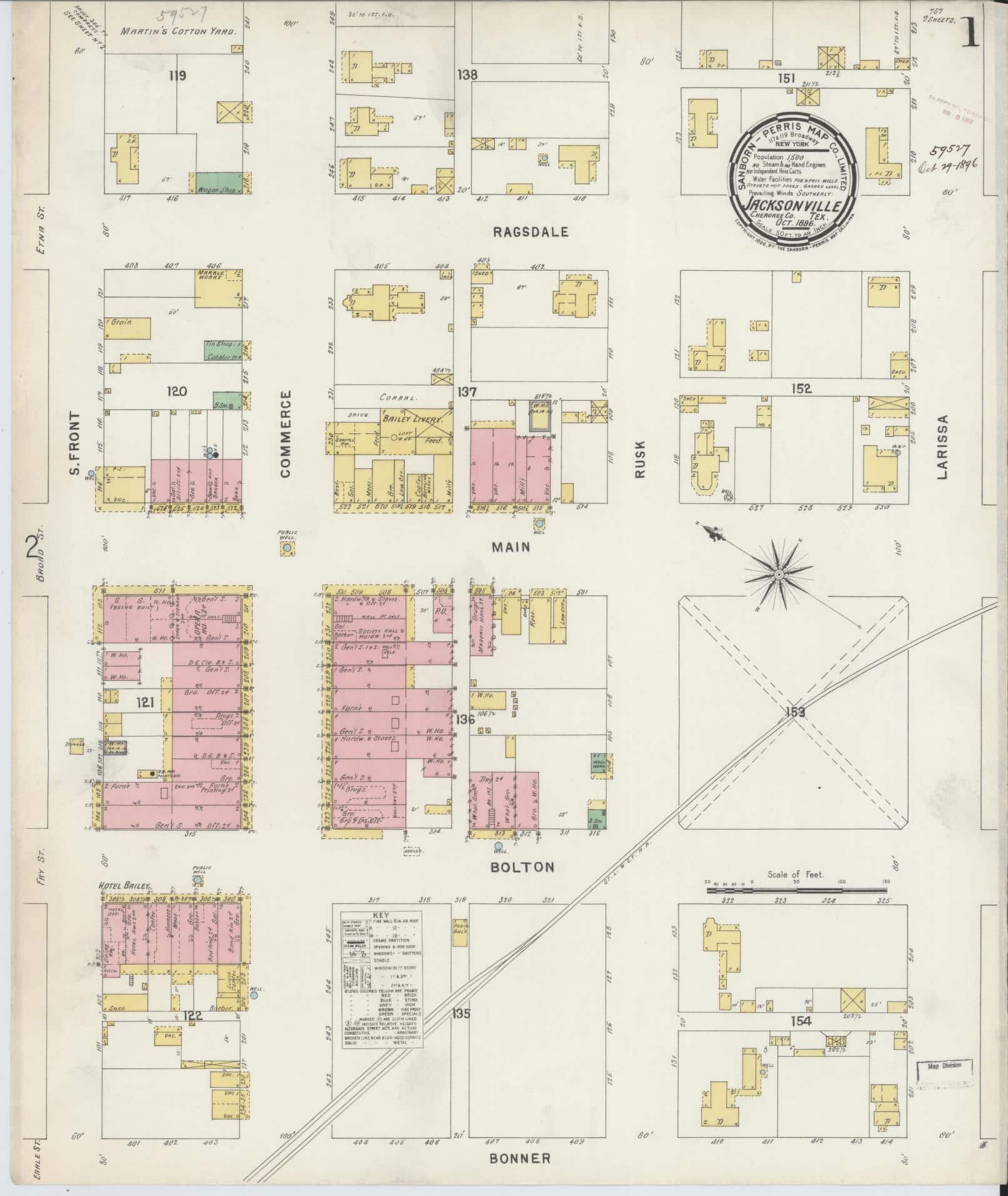
Before the Tomatoes
Jacksonville was peach country first
Jacksonville’s first major fruit boom was built around peaches, nurseries, packing sheds, and the railroad.
Cherokee County history credits the Rev. N. A. Davis, a Cumberland Presbyterian minister and nurseryman, with planting Jacksonville’s first peach orchard in 1878.
In 1881, John Wesley Love and M. L. Hodges established an Elberta peach orchard north of Jacksonville. Love continued expanding his orchards until his largest operation stretched south from what became Love’s Lookout and covered approximately 600 acres.
Packing sheds stood along the railroad so the fruit could move quickly to distant markets. In a record season, Love shipped more than 100 carloads of his own peaches. His success made him widely known as Jacksonville’s “Peach King.”
Jacksonville’s first peach orchard
Local history credits the Rev. N. A. Davis with planting the first commercial peach orchard in Jacksonville.
Love and Hodges expand the industry
Their Elberta orchard became part of a much larger fruit business that eventually covered hundreds of acres.
An orchard becomes a landmark
The scenic land associated with Love’s enormous peach orchards later became Love’s Lookout Park. After Love’s death, his family gave the lookout acreage to the State of Texas, and the city and WPA later helped develop the park.
Agriculture and the railroad worked together.
Farmers could grow fruit around Jacksonville, bring it into town, pack it near the tracks, and move it to distant buyers before the crop spoiled.
The peach business also encouraged packing, box and basket manufacturing, nursery operations, and other supporting work.
The Tomato Era
Jacksonville becomes a tomato town
Tomatoes were not simply a nickname or festival theme. For decades, they were part of Jacksonville’s economic machinery.
Cherokee County history records that the first crate of tomatoes from the county left Jacksonville on May 27, 1897, and attributes the shipment to S. H. Jarratt.
After the peach industry declined, tomatoes became Jacksonville’s primary agricultural crop after 1914 and remained central to the area’s economy into the 1950s.
Cherokee County history describes the scale of that growth as remarkable. By 1917, it reports that about 90 percent of the tomatoes shipped from Texas were coming from within an eight-mile radius of Jacksonville.
Fields around Jacksonville
Tomato production spread across farms surrounding the city, tying rural agriculture directly to Jacksonville’s economy.
Packing sheds
Tomatoes moved through packing operations where produce was prepared for shipment to markets outside East Texas.
Refrigerated railcars
Rail transportation made it possible to move perishable produce from Jacksonville to distant buyers.
Boxes, baskets and jobs
The tomato economy supported more than farming. Packing, transportation, box and basket production, and related businesses became part of the system.
At the height of the industry, tomato season changed the rhythm of Jacksonville. Growers brought green tomatoes to buyers and shippers, and packing sheds operated along the railroad lines.
Cherokee County history describes women packing green tomatoes into wooden lugs for shipment to markets across the country. Packers were paid according to the number of lugs they completed, so the fastest workers earned the most during the short, intense shipping season from late May into early July.
Tomatoes that did not meet fresh-shipping grades could move into canning operations instead. Jacksonville and the surrounding county developed canneries that extended the life of the crop and created another layer of seasonal employment.
The produce economy connected farms to another Cherokee County resource: timber. In 1896, Edgar Aber and Fred Haberle added a crate-and-basket operation to their Jacksonville woodworking business. Sweetgum trees could be cut, turned into veneer and baskets, delivered to packing houses, filled with fruit, and loaded into refrigerated railcars in remarkably little time.
Other container makers followed. The Slover operation that began outside Jacksonville eventually became the Texas Basket Company and moved to Jacksonville in 1948. At one time, three of Texas’s basket factories operated in Jacksonville, tying timber, woodworking, peaches, tomatoes, and rail shipping into one local industrial system.
Jacksonville became widely associated with the Tomato Capital identity. Even after tomatoes stopped dominating the local economy, that agricultural history remained part of how Jacksonville understood and represented itself.
A Railroad Crossroads
The tracks that moved the town kept shaping Jacksonville for generations
The railroad relocation of 1872 was only the beginning of Jacksonville’s transportation story.
Additional lines increased Jacksonville’s reach. The Cotton Belt provided passenger, mail, and express service through the area, and the Texas & New Orleans Railroad reached Jacksonville in the early twentieth century. Together with the International-Great Northern, those connections made Jacksonville a significant East Texas rail point.
The railroad district was more than a depot. Freight yards, produce packing sheds, basket factories, cotton facilities, livestock loading, warehouses, and businesses clustered around the tracks because that was where Jacksonville connected to outside markets.
Rail service also connected people. Passenger trains carried residents, students, salesmen, mail, visitors, and workers. The Cotton Belt’s long-running passenger, mail, and express service between Tyler and Lufkin ended in 1949, one sign that the transportation system was changing.
As automobiles and paved highways became more important, Jacksonville’s regional connections shifted toward roads. U.S. Highways 69 and 79 increasingly performed the role that railroads once held so strongly: bringing people, goods, customers, and opportunity through the city.
More than one line
Jacksonville grew from a town that moved to meet one railroad into a community served by several major rail connections.
The tracks powered commerce
Produce, timber products, livestock, manufactured goods, mail, and other freight moved through Jacksonville’s rail facilities.
Roads take the regional role
As passenger rail declined, highways and automobiles increasingly became the way Jacksonville connected with East Texas.
A Community Takes Root
Schools, newspapers, churches and healthcare build a city
Agricultural growth explains part of Jacksonville’s rise, but farms and railcars alone do not make a city.
Jacksonville was also developing institutions that gave the community stability and identity.
Jacksonville College opened in 1899. The Daily Progress began publication in 1910, adding another chapter to a local newspaper tradition that already included the Texan Intelligencer and Cherokee Argonaut.
Healthcare was becoming part of Jacksonville’s institutional growth as well. Cherokee Sanitarium was founded in 1919, beginning another important part of the city’s development as a regional center.
Churches, schools, newspapers, healthcare, businesses, and civic organizations were giving Jacksonville something the railroad and agricultural economy alone could not provide: permanence.
Jacksonville College
Higher education became part of Jacksonville’s identity with the opening of Jacksonville College.
The Daily Progress
Jacksonville’s newspaper tradition continued with the establishment of the Daily Progress.
Cherokee Sanitarium
Healthcare became another important Jacksonville institution as the community continued growing into a regional center.
,_Vol._11,_No._34,_Ed._1_Friday,_January_20,_1899_-_DPLA_-_10014644f0e6cfc0ad59c3422a9b07f0_(page_1).jpg)
A Musical Jacksonville
Jacksonville helped launch a Southern gospel publishing story
Jacksonville’s influence reached beyond agriculture and business. Gospel singer, teacher, promoter, and publisher Virgil O. Stamps ran the Jacksonville office of the Vaughan Publishing Company from about 1915 into the 1920s.
In 1924, Stamps opened the V. O. Stamps School of Music in Jacksonville. He later partnered with J. R. Baxter Jr., and by 1927 their business was known as the Stamps-Baxter Music and Printing Company.
Stamps-Baxter became one of the country’s most influential Southern gospel music publishers, promoting songbooks, quartets, music schools, radio programs, and shape-note singing.
Stamps moved his western operations to Dallas in 1928, but Jacksonville was an important early base in a music enterprise that reached far beyond East Texas.
Read the Handbook of Texas biography →Jacksonville the College Town
Higher education became part of Jacksonville’s identity
For much of the twentieth century, Jacksonville supported several institutions of higher education at the same time.
Lon Morris College moved to Jacksonville in 1894, where it first operated as Alexander Collegiate Institute. The school became Lon Morris College in 1924. In 1927, it became the first Texas junior college accredited by the Southern Association of Colleges and Schools.
Jacksonville College opened in September 1899 with 34 students. By the end of its first term, enrollment had grown to 85. Before Christmas that year, the college moved into a three-story brick building known as Old Main. It was reorganized as a junior college in 1918.
A third institution joined Jacksonville’s education landscape in the 1950s. The school now known as the Baptist Missionary Association Theological Seminary was established in 1955. Its Jacksonville campus opened on September 8, 1957, with a charter class of 57 students.
These institutions brought students, faculty, churches, performances, athletics, jobs, and visitors into Jacksonville. Education became one of the ways the city served a region much larger than its own population.
Lon Morris comes to Jacksonville
The Methodist school moved to Jacksonville as Alexander Collegiate Institute and later became Lon Morris College.
Jacksonville College opens
The college began with 34 students and grew quickly during its first term.
Seminary classes begin
The theological seminary opened its Jacksonville campus with 57 students after being established two years earlier.
Lon Morris College remained part of Jacksonville for more than a century before closing in 2012. Jacksonville College and the Baptist Missionary Association Theological Seminary continue the city’s higher-education tradition.
Jacksonville Becomes a Medical Center
A 12-bed sanitarium grows into regional healthcare
Healthcare became another reason people from across the area traveled into Jacksonville.
On July 1, 1919, Cherokee Sanitarium opened in Jacksonville with 12 beds in the former home of Dr. and Mrs. E. E. Guinn.
Growth came quickly. In 1925, a new 40-bed hospital was built. In 1930, the institution was reorganized and renamed Nan Travis Memorial Hospital.
The hospital continued expanding. A new wing was completed in 1937. A major 1953 addition increased capacity, and in 1970 a large modern addition brought new operating suites, diagnostic services, intensive-care improvements, and other facilities.
Jacksonville also supported other medical institutions, including Newburn Memorial Hospital and the Travis Clinic. Together, hospitals, clinics, physicians, nurses, and support staff helped establish Jacksonville as a healthcare center for surrounding communities.
Cherokee Sanitarium opens
The city’s hospital story began with a 12-bed facility in a converted Jacksonville residence.
A larger hospital and a new name
A 40-bed hospital opened in 1925, and the institution became Nan Travis Memorial Hospital in 1930.
Regional medical growth
Major additions expanded bed capacity and brought newer medical facilities to Jacksonville.
Healthcare changed Jacksonville’s regional role. The city was no longer simply a place to ship crops, attend school, or shop. It was increasingly a place people came for medical care.
Black Education and Community Life
Fred Douglass schools became anchors of Black Jacksonville
Jacksonville’s growth was experienced differently across the community because schools and many public institutions developed under racial segregation.
In 1922, Jacksonville built its first Fred Douglass School for Black children. Cherokee County history records that local money was supplemented by funding from the Julius Rosenwald Foundation. The building included six classrooms, a principal’s office, a book room, and an auditorium.
In 1951, the district awarded a contract for a new Fred Douglass High School on Gaston Street, adjacent to the earlier school. The new high school cost $308,490 and served Black high-school students until 1970.
Jacksonville began a freedom-of-choice system for elementary students in 1966. By the fall term of 1970, the school system was integrated. The former Fred Douglass High School then took on new educational uses.
Schools were only one part of Black community life. Historic African American churches such as Old Sweet Union Baptist Church served as places for worship, family life, organization, leadership, and community support across generations.
The first Fred Douglass School
Jacksonville built a six-classroom school for Black children with local funds supplemented by the Rosenwald Foundation.
A new Fred Douglass High School
A new high-school building was contracted on Gaston Street and remained the Black high school until 1970.
The school system integrates
Freedom of choice began for elementary students in 1966, and Jacksonville’s school system was integrated by fall 1970.
Harold Alexander
Cherokee County history records that Harold Alexander graduated from Fred Douglass High School in 1933 and later became an active Jacksonville civic leader.
His local service included work connected with youth sports, Head Start, and other community efforts. His story offers one example of the people whose work shaped Jacksonville beyond the better-known railroad, agriculture, and industrial stories.
The school timeline is now well documented, but Black Jacksonville’s neighborhoods, businesses, churches, family stories, teachers, student life, and experiences during integration deserve much deeper preservation through newspapers, church records, school records, photographs, oral histories, and family collections.
Downtown Jacksonville
Business, institutions and everyday life gather in town
As Jacksonville grew, downtown became an increasingly important setting for commerce, services, employment, newspapers, banking, shopping, and civic life.
Newspaper records document businesses such as Childs Brothers Grocery, one of the early Jacksonville businesses now visible through surviving historical records.
The story of downtown Jacksonville stretches across generations of storefronts, businesses, offices, public buildings, and community activity.
Many individual building histories are still being reconstructed through newspapers, historical photographs, maps, property records, and Cherokee County archives.
That research will eventually allow Jacksonville’s changing streetscape to be shown in even greater detail.
Jacksonville Takes to the Air
A municipal airport became a wartime training field and later a factory site
Transportation was changing again, and Jacksonville invested in aviation.
The city purchased land about two miles north of town along U.S. 69 in 1933. Jacksonville Municipal Airport was established the following year, becoming the first airport in Cherokee County.
Before World War II, the field served local pilots, transient aircraft, barnstormers, and private instructors. In 1940, Lon Morris College opened a contract flying school there to train U.S. Navy Reserve pilots. The program became part of Jacksonville’s wartime contribution as pilot training intensified.
The site later entered an entirely different chapter of Jacksonville history. In 1955, Nichols Industries moved its manufacturing operation onto the former municipal airport property. A place built for aviation became one of the city’s major industrial sites.
Jacksonville Municipal Airport
The city’s new airfield became the first municipal airport in Cherokee County.
Wartime pilot training begins
Lon Morris College operated a contract flying school training U.S. Navy Reserve pilots at the Jacksonville airfield.
Runways give way to industry
The old airport property became the Jacksonville home of Nichols Industries.
A Jacksonville Landmark
The Tomato Bowl rises on the East Side School site
In the final years of the Great Depression, Jacksonville began work on a structure that would become one of the city’s most recognizable landmarks.
Planning begins
Jacksonville ISD history records that plans for a new stadium were moving forward by 1938.
WPA assistance
The school district’s application for assistance through the federal Works Progress Administration was approved in August 1939.
Football comes to the new stadium
The first athletic contest at the new Tomato Bowl was played on September 27, 1940, even though the project was not yet completely finished.
The stadium was constructed on the site of the original East Side School on East Commerce Street. Materials from the demolished school were reused as part of the stadium project.
From there, the Tomato Bowl became part of generations of Jacksonville life. It became the longtime home of Jacksonville High School football and a place associated with school events, graduations, community gatherings, and local memory.
Its location near downtown also made the stadium unusual. Instead of sitting far outside the city’s traditional center, the Tomato Bowl remained physically connected to Jacksonville’s older civic landscape.

Imagine Jacksonville Then
A railroad, tomato, college and factory town all at once
A surviving local account from the early 1940s gives us a rare picture of how Jacksonville may have felt to someone arriving in town.
Jacksonville then had colleges, hospitals, banks, hotels, three railroad connections, basket factories, sawmills, packing sheds, and tomato farms surrounding the city. The Tomato Bowl, post office, and Love’s Lookout Park were all relatively new landmarks.
Steam locomotives hauled tomato shipments through town. Factory and sawmill whistles marked the workday. Students came to Jacksonville for college, farm families came to sell and ship produce, and workers moved between packing sheds, mills, stores, hospitals, and factories.
That Jacksonville was still recognizably connected to the farming community around it, but it was already becoming the regional center that later generations would know.
Want to stay in 1940 a little longer?
The main history page gives the broad timeline. Our Jacksonville, Texas in 1940 story goes deeper into the city people knew that year, including downtown life, tomato season, public construction, manufacturing, aviation, Black Jacksonville, and everyday life.
Explore Jacksonville, Texas in 1940Local memories describe train whistles, basket-factory whistles, sawmill whistles, and the movement of produce through town. History was not only visible. It had a sound, a work schedule, and a season.
A New Kind of Jacksonville Industry
From one sewing machine to a major local employer
Jacksonville’s economy was beginning to move beyond agriculture.
In 1938, Margia Childs founded the Marja Brassiere Co. in Jacksonville.
According to Cherokee County history, the business began with one sewing machine and two helpers.
From that small beginning, Marja grew into a major Jacksonville manufacturer and eventually employed more than 250 people.
Historical research places its principal operations in downtown Jacksonville near Commerce and Main Streets. The company produced brassieres and became an important part of the city’s mid-century manufacturing economy.
A local beginning
Margia Childs started Marja Brassiere Co. with one sewing machine and two helpers.
Hundreds of local jobs
County history records that the operation eventually employed more than 250 people, making it an important Jacksonville employer.
Manufacturing changes local work
Marja’s workforce made the company an important part of the history of women’s employment and manufacturing in Jacksonville.
Jacksonville was changing. The fields and packing sheds remained part of the community, but factory work was becoming another major piece of the local economy.
Postwar Industry
From toy pistols to Olde Jacksonville fans
By the middle of the twentieth century, Jacksonville was becoming much more than an agricultural shipping town.
In 1955, Nichols Industries relocated operations from Pasadena to Jacksonville. Cherokee County history records that the company moved its plant to the old Jacksonville airport on U.S. Highway 69 North.
Nichols became known for manufacturing toy pistols and cap guns, adding another kind of factory work to Jacksonville’s growing industrial economy.
The company later became Nichols-Kusan after being purchased by a Bethlehem Steel subsidiary.
Nichols-Kusan eventually produced ceiling fans under the Olde Jacksonville trade name. Cherokee County history says development of the Old Jacksonville ceiling-fan program helped the company grow to approximately 850 employees and made it the largest industrial employer in Cherokee County at that time.
The old airport becomes a factory
The former Jacksonville airport property became the location of a major manufacturing operation as Nichols Industries established itself in the city.
Toy pistols and plastics
Nichols produced toy pistols and became part of a broader Jacksonville manufacturing economy involving plastics, tooling, die casting, and related businesses.
The Olde Jacksonville name
Nichols-Kusan later produced ceiling fans under the Olde Jacksonville trade name, connecting the city’s name to one of the company’s best-known product lines.
Nichols helped introduce plastic molding technology to Jacksonville. Cherokee County history records that at least a dozen allied plastics businesses later developed in and around the city, including injection-molding operations and tool-and-die shops. Medi-Vac, founded in 1975, manufactured plastic suction devices for hospitals, while Progressive Polymers later engineered plastic resins for other manufacturers.
The economic story had changed again. Jacksonville had moved from a community centered heavily on agriculture into one where factories, manufacturing, plastics, healthcare, education, retail, and other industries were becoming increasingly important.
Building for the Future
Jacksonville builds a municipal water supply
Lake Jacksonville is now closely associated with fishing, boating, swimming, camping, and lake life.
But recreation was not the reason the lake was originally built.
Lake Jacksonville was created as a municipal water-supply reservoir for the city.
Construction began in February 1956 on Gum Creek in the Neches River basin.
Texas Water Development Board records place completion of the dam in 1957.
The project represented another stage in Jacksonville’s development. The city was no longer simply responding to transportation routes or agricultural markets. It was building major infrastructure intended to support long-term community growth.
Over time, Lake Jacksonville took on a second identity. What began primarily as a water-supply project also became one of the area’s most important recreation destinations.
Fishing, boating, swimming, camping, lakeside homes, and community gatherings gradually made the lake part of everyday Jacksonville life.
Construction begins
Work began on the municipal reservoir that would become Lake Jacksonville.
TWDB records dam completion
Texas Water Development Board records place completion of the dam in 1957, after construction began in 1956.
Water supply becomes lake life
Recreation gradually became an important second role, adding fishing, boating, camping, swimming, and lakeside living to Jacksonville’s identity.
A Growing Regional Center
Jacksonville becomes more than an agricultural town
By the middle of the twentieth century, many pieces of modern Jacksonville were beginning to exist at the same time.
Agriculture remained part of the surrounding economy, but manufacturing was expanding. Schools continued developing. Churches remained important community institutions. Healthcare served Jacksonville and surrounding rural communities. Businesses and retail activity continued to grow.
By then, public schools, colleges, theological education, hospitals, churches, manufacturers, retailers, and service businesses were all operating within the same community.
Jacksonville’s role was becoming increasingly regional. People from communities outside the city came into Jacksonville for education, healthcare, shopping, employment, religious life, business, entertainment, and public services.
A city of schools and colleges
Public schools, Jacksonville College, Lon Morris College, and later theological education gave Jacksonville an educational role larger than its population alone might suggest.
Serving the surrounding region
Healthcare institutions helped establish Jacksonville as a place people from surrounding communities traveled to for medical care and services.
Retail and services expand
Jacksonville increasingly served as a commercial center for people living across a wider part of Cherokee County.
A Changing Community
Jacksonville continued to change with the people who called it home
Economic development was only one part of Jacksonville’s changing story. The city was also shaped by changes in education, congregations, families, neighborhoods, and community institutions.
Black Jacksonville residents built schools, churches, businesses, organizations, and civic traditions during decades when segregation limited access to many public institutions.
Fred Douglass High School and historic African American churches such as Old Sweet Union Baptist Church remain important anchors for understanding that history.
Jacksonville’s religious community also continued evolving. Cherokee County history records that local Catholics bought an old frame Cumberland Presbyterian Church building in 1909. Our Lady of Sorrows became a resident parish on September 15, 1954, and a new brick church was erected on Corinth Road in 1958. The parish remains part of Jacksonville’s religious life today.
The city’s complete social history is still being reconstructed. School records, church records, newspapers, oral histories, photographs, family collections, and local archives will continue adding detail to the story.
Jacksonville’s history belongs not only to prominent businesses, institutions, and buildings, but also to the families, workers, congregations, teachers, students, farmers, factory employees, merchants, and neighborhoods that built everyday life here.
Preserving Knowledge and Memory
Jacksonville’s library grew from borrowed rooms into a civic institution
Jacksonville’s public library story began with volunteers long before the city had a permanent library building.
After the Rev. Tom Dean arrived in Jacksonville in 1909, supporters began organizing a public library. An upstairs room above Tucker Furniture Company on East Commerce Street housed the first collection, and the Jacksonville Library Association was formally organized in 1912.
The library moved through several temporary homes before voters and city leaders secured a permanent building. Completed in 1941 with Works Progress Administration assistance, the new library was built of pink native rock quarried near Alto.
A 1965 addition expanded the library and created space for the Vanishing Texana Museum. In 1983, Jacksonville formally opened a much larger library in a remodeled former grocery store on South Jackson Street after a community fundraising campaign.
The library later moved again, while the Vanishing Texana collection developed into a separate museum devoted to preserving local objects, photographs, documents, and stories.
The Library Association forms
Volunteers organized a formal association after Jacksonville’s first library efforts began above a downtown furniture store.
A permanent WPA-era library
Jacksonville opened a purpose-built public library constructed with pink native rock.
Museum space and a larger library
The Vanishing Texana collection gained dedicated space, and a much larger library opened in a remodeled commercial building in 1983.
Jacksonville began preserving its own story while that story was still unfolding. The library and Vanishing Texana Museum became places where newspapers, books, artifacts, photographs, and local memory could survive changes that erased many older businesses and buildings.
Another Transition
The economy changes, but Jacksonville remains a regional center
By the late twentieth century, Jacksonville looked very different from the agricultural shipping town that had flourished during the peak tomato era.
Commercial tomato production no longer dominated the local economy. Manufacturing changed as companies expanded, reorganized, were sold, or eventually disappeared.
The city increasingly depended on a broader mix of healthcare, education, retail, manufacturing, government, professional services, restaurants, banking, small business, and regional commerce.
Transportation had changed too. The railroads that once dictated Jacksonville’s location were no longer the center of everyday travel. Highways, trucks, and automobiles increasingly carried the people and commerce moving through the city.
Lon Morris College, which had been part of Jacksonville’s educational landscape for generations, closed in 2012.
Institutions changed and industries changed, but Jacksonville continued serving much the same regional function it had developed over the previous century: a place where surrounding communities came together for everyday needs.
What Jacksonville Carried Forward
The old Jacksonville is still visible inside the modern one
Jacksonville’s economy has changed repeatedly, but pieces of earlier Jacksonville remain visible everywhere.
The railroad explains why the town moved to its present location. Agriculture explains the city’s tomato identity. The Tomato Bowl connects school pride with Depression-era public works and generations of community memory.
Lake Jacksonville reflects the period when city leaders were building infrastructure for a growing community. Historic churches and schools carry memories of communities that built institutions during segregation. Old industrial stories survive in names such as Marja, Nichols-Kusan, and Olde Jacksonville.
Downtown buildings, old photographs, newspaper advertisements, family records, school yearbooks, church histories, and surviving landmarks continue telling parts of the same story.
Tomato identity
Jacksonville’s agricultural era continues through local traditions, community memory, public branding, and Tomato Fest.
The Tomato Bowl
The historic stadium remains a visible connection between downtown Jacksonville, school history, athletics, and civic life.
Lake Jacksonville
A municipal water project became one of Jacksonville’s most recognizable recreation and residential areas.
Stories still being recovered
Newspapers, photographs, oral histories, maps, school records, church records, and family collections continue revealing parts of Jacksonville’s past.
The City the Story Built
A regional East Texas community shaped by every era before it
Modern Jacksonville is the result of nearly two centuries of movement, adaptation, building, loss, growth, and reinvention.
Today, Jacksonville remains the largest city in Cherokee County and serves residents from a much wider area than the city limits.
People come into Jacksonville for schools, healthcare, restaurants, shopping, banking, employment, recreation, government services, youth activities, churches, businesses, and community events.
U.S. Highways 69 and 79 now provide the regional connections that rail transportation once provided so dramatically in the nineteenth century.
Jacksonville College remains part of the city’s educational landscape. Lake Jacksonville remains part of its recreation and water story. The Tomato Bowl remains part of school and community life. Downtown still occupies the city created after the railroad relocation of 1872.
The details have changed.
The basic role Jacksonville plays in the region has not.
Schools and learning
Public schools and higher education remain important parts of Jacksonville’s regional role.
Explore Schools & Education →Regional medical services
Healthcare remains one of the reasons residents from across the surrounding area travel into Jacksonville.
Explore Healthcare →Businesses and services
Retail, restaurants, manufacturing, professional services, small businesses, and other employers support the modern city.
Browse the Directory →Events, recreation and connection
Lake life, school activities, festivals, churches, parks, sports, and community events continue bringing people together.
Explore Jacksonville →The Jacksonville Story
A town that kept adapting
Jacksonville began beside Gum Creek after an earlier period of Native displacement and rapid settlement in Cherokee County.
The Civil War disrupted the young town. When the railroad later missed Jacksonville, the community moved.
When agriculture changed, Jacksonville moved from peaches to tomatoes, while packing sheds, baskets, railcars, and supporting businesses grew around the crops.
Schools, colleges, Black community institutions, hospitals, factories, plastics, retail, and services gradually made Jacksonville a regional center for much more than agriculture.
Railroads gave way to highways. An airport became a wartime training field and then an industrial site. Gospel publishing carried a piece of Jacksonville into churches across the South, while the library and Vanishing Texana Museum worked to preserve what earlier generations left behind.
A municipal reservoir became a lake community. A Depression-era stadium became a civic landmark. Factories became memories and local names. Old schools and churches became pieces of a larger story still being reconstructed.
Jacksonville’s history is not one story of uninterrupted growth. It is a story of repeatedly changing while remaining useful to the people who call this part of East Texas home.
And that story is still being written.
Sources & Further Reading
Building the history from documented sources
This page brings together information from state and local histories, public agencies, educational institutions, archival collections, newspapers, and historical research. Some parts of Jacksonville’s history remain better documented than others, and this page will continue to grow as stronger local records are located.
About the historical images on this page
Public-domain and openly licensed images are displayed with their source and credit information. Additional Cherokee County Historical Commission photographs have been identified for this history and will be added only if reuse permission is granted.
Some Jacksonville history is still being researched
Detailed histories of historic downtown buildings, former businesses, Latino community history, old neighborhoods, individual railroad facilities, industrial sites, and many local institutions still contain gaps in the surviving or easily accessible record.
We would rather identify those gaps than turn local tradition into unsupported fact.
Help Preserve Jacksonville History
Do you have a piece of the story?
Some of Jacksonville’s best history may still be sitting inside family photo albums, old business records, church files, school programs, yearbooks, newspapers, letters, postcards, maps, or personal collections.
If you have historical photographs, documents, corrections, first-hand knowledge, or reliable sources that can help make this page more complete, we would like to hear from you.
Jacksonville, Past and Present
Keep exploring the city
History explains how Jacksonville became the community it is. The Our Town guides help you find the Jacksonville that exists today.